The New Way to Mail a Message – Every Door Delivery

Forget all the fancy social media platforms — Facebook, Twitter, Pinterest, Google+. Well, at least forget them until Direct Mail Legsyou’ve got the basics covered, meaning mail — from snail mail to e-mail to the newest type of mail — Every Door Direct Mail™.

Advertising is about getting your message delivered to the right customer. Mail is one of the original ad delivery vehicles, and although now out of favor, can still be an effective way to reach a geo-targeted audience, especially if done in a modern way. Direct mail, the original mailing mechanism through the post office, is now expensive and inefficient leading digital age advertisers to move from snail mail to e-mail. But, the surprise and delight factor is not the same. Whereas “junk mail” was frequently fun to receive; spam is not.

Unlike email, direct mail is a tactile experience. To this day, with the exception of  bills, everyone generally still  loves getting mail. It’s the reason direct mail will never totally go away. But, now, a new affordable replacement is literally on everyone’s doorstep – targeted house delivery, or Every Door Direct Mail. How’s Every Door Direct different from Direct Mail?

  • The piece is not personalized. Although not as strong as a personalized piece, for the greatly reduced cost, it gets your message directly into the home. The plus side is the mailer also doesn’t have to preprint addresses on each piece.
  • It can  be geo-targeted, something extremely valuable particularly for local retailers and service businesses. Do you want to reach all households in a particular zip or carrier route? This does it.
  • The mail is  still “delivered” by the postal service (USPS), but all the paperwork is done by the Every Door vendor.
  • The piece can range from a door hanger, to a flyer, or even an item in an envelope. In other words, you don’t have to abide by Postal standards for size or weight.
  • It’s a lot less expensive. Whereas a first class piece can range from 37 cents to well over a dollar depending on size, a Direct Delivery piece is generally less than 20 cents per household.

Today, targeted house delivery is available through a series of private party providers, including local newspapers. In South Jersey, The Press of Atlantic City is making the service available, just as other providers are across the nation. Is it an option for you? It is, likely, at least an option you should explore by talking to your local Every Door Direct representative or call (609) 272-7002.

The Walk-away: Direct mail has evolved with more options for unique targeting and creative designs to cut through the clutter. Walking to get your mail is still exciting when you get an unexpected delivery message in a unique way.


Is It Worth Paying for Color in Print Ads?

What’s the value of color for a print ad?  For most publications, color is an up-charge from as low as $2 per inch to sometimes more than double the base charge. How can you determine if it’s worth the additional investment?

In general, research consistently shows that color ads out pull black and white ads of the same size with the same message. One 2009 study on color ads in US Newspapers conducted by Research and Analysis of Media found the following:

Color helps readers remember ads.

  • Full color increased ad recall (readers who remembered seeing an ad) by 23%.
  • Spot color increased ad recall by 15%.

Color helps ads of all sizes, but has the most impact  on full page ads.

  • Recall went up by 6% in quarter page ads, 8% in half page ads, and 23% in full page ads.

Color makes an advertiser appear interesting and fresh.

  • 15% found the ads more interesting and 29% said the ads communicated a fresh approach.

Color drives traffic and a reader’s potential to buy from the advertiser.

  • When compared with the same ad in black and white, 6% more said they would seek more information,while 8% more said they would visit the advertiser.
  • 12 % more said they either have bought or plan to buy from the advertiser.

These are compelling reasons to consider color, but as with all ad techniques, there are no hard and fast rules. If you’re a high-end, luxury retailer advertising in an artsy magazine, you could make the case that a glossy black and white ad makes the statement you need.  It this case, the black and white choice is not about budget, but a desired image. For most small to mid-sized businesses, the  data on color indicates you should try to present your message through rose, if not multi-colored glasses.

The Walk-away: Color in print helps readers see you more clearly. It generally makes them more willing to engage with you rather than stepping aside and letting you pass  by.

Packaging – The Frequently Overlooked Marketing Key

Every marketing student learns about the five “p’s” of marketing – Pricing, Place, Product, Promotion, and People. The missing “P” is packaging, which some will teach is part of Product, and others will claim is part of Promotion. Either way, it’s frequently the forgotten child of marketing that can spell business success or failure.

A key case in point is Coca-Cola. Without a doubt, Coke is always discussed in conversations about great brands. Recently, the story of Coke was featured on CBS Sunday Morning, itself a perennial news brand. As the story goes, Coca-Cola was so successful, that me-too products popped up around the globe. In a marketing meeting, Coke executives realized their brand franchise was in danger, and decided to invent brand packaging – the now iconic coke bottle – so that even in the dark, by feel alone, a consumer would know “the real thing” from a substitute. When aluminum cans became the norm, color became a larger concern for differentiating the brand, and Coke’s “red” became another text-book marketing example of the importance of color in serious brand management.

How does this apply to you if you’re a small to mid-sized business not of Coke caliber? Don’t underestimate packaging as a key differentiating factor. Packaging means everything from how you label your business to how you package your goods and services. Consider these examples:

  • Where The Art Is – This party decorations firm located in Paramus, NJ was literally started out of a garage. The decorations are unique and memorable, with many centerpieces kept for years to come in the homes of the guests and/or hosts. Under each piece is the company’s label with contact information. If you want a party decorator years later, you’ll be able to find Where The Art Is due to a simple packaging label.
  • Chico’s – Now a well known women’s wear franchise, the store endeared itself to women through a wrinkle-free travel line that was also figure forgiving. Priced high, consumers don’t feel cheated as each purchase is carefully wrapped generously in beautiful tissue paper and each bag is tied off with rainbow ribbons. Both touches are not necessary and add extra expense, but both are part of the Chico’s experience and brand.
  • Two Tin Crows – This unique gift store in Northfield, NJ (outside of Atlantic City), makes sure that gifts are beautifully wrapped using bags folded just so. It’s a simple technique, but one done exquisitely by the owner. It takes the added expense of gift wrapping off the consumer and makes the purchase that much easier. The point of these three examples is that it only takes a little extra effort to make your packaging work wonders for you as a differentiating value proposition.

The Walk-away: Take a look at your packaging, from your windows to your logo. Are you doing all you can to put your best look — if not foot — forward? Packaging is a Key “P” in Marketing.

For Advertising Wisdom – Go Fly a Kite

Advertisers frequently make the mistake of putting out one ad, one time, and waiting to see what happens. If it works, they think, they’ll do it again. And, if it doesn’t, they won’t. The odds are very strong the ad won’t work because their ad strategy is, in effect, spitting into the wind. To understand why, let’s take the analogy a bit higher and drier. Let’s go kite flying.

Ads with legs kite photoImagine your ad is a kite on a long string and you fly it once for 5 minutes. That’s a long time because the average ad is seen or heard for less than 30 seconds in broadcast, and under one minute in print. How many people do you think will have seen your kite and commented on it?

What if your kite stays up for hours on end? That’s called Frequency –  meaning that you’re giving consumers several options for seeing your kite over time.

Finally, fly your kite on a crowded beach during the height of summer. That’s called Reach. You’re reaching thousands more people than if you flew the same gorgeous kite for the same amount of time in a desolate area.

Now, let’s assume your kite is a plain white kite. Even if it’s the only one in the sky, it may get overlooked as it blends with the clouds. It is not distinctive. In this case, it’s seen but not remembered and has no impact. Make your kite colorful, or extraordinarily designed, and it now stands out. That’s called getting noticed, the first key component in an increasingly cluttered competitive field.

But, what if you need your kite to be noticed during a windy day when everyone’s come out to fly kites? You might be better off having that plain white kite to set you apart from the sea of colorful kites. In design that’s a positive use of negative space, or differentiation.

Now, imagine you fly your kite long enough to break the Guinness Book of World Records. What type of PR benefits will you now get? Welcome to the world of public relations – a topic for another time.Ads with legs plane photo

The Walk-away: Ads that work let you successfully fight the battle for client attention and send your business soaring. But, as the Wright Brothers knew, flying successfully takes practice and planning. Advertising, like aerodynamics, is a science. Study the principles and you could be flying in no time like a trained pro.

Not All Ad Positions Are Created Equal

In advertising, not all ad positions are created equal. That should come as no surprise to advertisers.  Every media has its star positions and remnants.

  • Radio morning drive time is valued over all other time slots.
  • In TV, prime time – 7-10pm – is the coveted time slot.
  • For magazines, right-paged ads get more eyeballs than left-page placements, and front of the book or inside covers are clearly premium spots.
  • In newspapers, above-the-fold positions are the“top” spots, but a below-the-fold strip ad on a section front also has extremely high value.

This is all common advertising wisdom, but effective ad placement is not always that cut and dry. Newspaper data, for instance, shows that comics and lifestyle columns are highly read and, yet, most advertisers overlook these key positions when creating their media plans. Don’t try to run next to Dear Abby or Garfield in The New York Times, since the Grey Lady doesn’t carry those features. But if you’re a local psychologist introducing a new service in an area served by a regional paper, an adjacency to Dear Abby or Carolyn Hax, Abbey’s younger counterpart in newspaper advice columns, might be just the ticket for getting the right eyeballs to your ad.

Positioning means just that – the position of your ad. It can include adjacencies to key features, or a “Blue Ocean” spot. For instance, a mortgage financing company should find that a newspaper ad adjacency to real estate listings is both more affordable than an above-the-fold ad in regional news AND more effective due to the readership affinity with real estate listing readers. The same would hold true in an online environment.

A “Blue Ocean” spot is one where other advertisers may not normally appear, giving you an open space, or blue ocean spot, to get your message clearly across without clutter from your competitors. An example of this is a recent real estate ad placed in Hometown, the zoned community section of The Press of Atlantic City, rather than in the real estate section. In this case, the realtor was effectively targeting interested residents from a specific area for attention to a unique property. It doesn’t mean the ad should not also run in real estate, but the positioning clearly set this ad apart from competitors. And that’s the point of all advertising — gain attention towards you and away from competitors.

Ad positioning is both an art and a strategic play. Great positioning means your ad is where  the right people will see, hear or interact with it. But positioning alone doesn’t make for ad effectiveness. For instance, an auto detailing ad in a Sunday afternoon radio hour may be inexpensive, but not worth the dollars paid for it. Why? Radio listenership plummets on weekends except for morning religious shows for the homebound.

No matter the media, great positioning is the result of being in the right place at the right time to reach the right people.

The Walk-away: Positioning is one leg of three-legged stool – with the other two legs always being Reach and Frequency. Just as with a stool, one leg of a media plan won’t give you a strong platform. You need all three solidly in place at all times.

Is Your Advertising Art?

Is your Advertising Art? If not, it’s likely not effective, because Advertising is Art. That’s why it’s generally done by well-trained graphic designers who understand the importance of visuals and getting the eye to connect to the brain. In terms of commercial advertising, the artistry of an ad is important for letting the consumer make an emotional connection to your business story.

Most small to mid-sized businesses make the error of treating their ads as glorified listings. Their ads display their company name, phone number and perhaps web address. Many company names are the owner’s name, giving the customer no clue as to what you do. The lack of creative copy does nothing to entice a new customer to give a company a try, or understand why your company is the one worth aligning with in a sea of similar businesses. And yes, the Copy is Art as well.

Not all exterminators, car dealerships, grocery stores, or gas stations are alike, and yet they tend to make their ads excruciatingly similar. Differentiation has always been critical, but is even more so in the digital age, when competitors are as likely to come from around the world as around the corner.

Want your advertising to be effective in connecting with a prospect or potential customer? Don’t save money on artists. Many broadcast and media companies offer to do your ads for free, or at low cost. It’s their way of enticing you to give their medium a try, and reduce your overall costs so you can afford their space costs without incurring other production fees. Unfortunately, Advertising is like everything else. You get what you pay for.

Have a limited budget? Give a rising young student a shot. Or, there are many freelancers out there today who would love to give you a good artist’s rate in exchange for the experience, added income, and portfolio beefing.  Good to great artists are worth their weight in gold, yet artists tend to be highly underpaid, so make a connection with someone now who will value your relationship and keep you looking “cool” long after they’ve been discovered and raise their own rates.

The Walk-away: Ads are not one-size fits all. An effective ad is exciting to watch and artfully gets your message across even in a very crowded field.

Lessons from a Leader – Ray Ban Ads

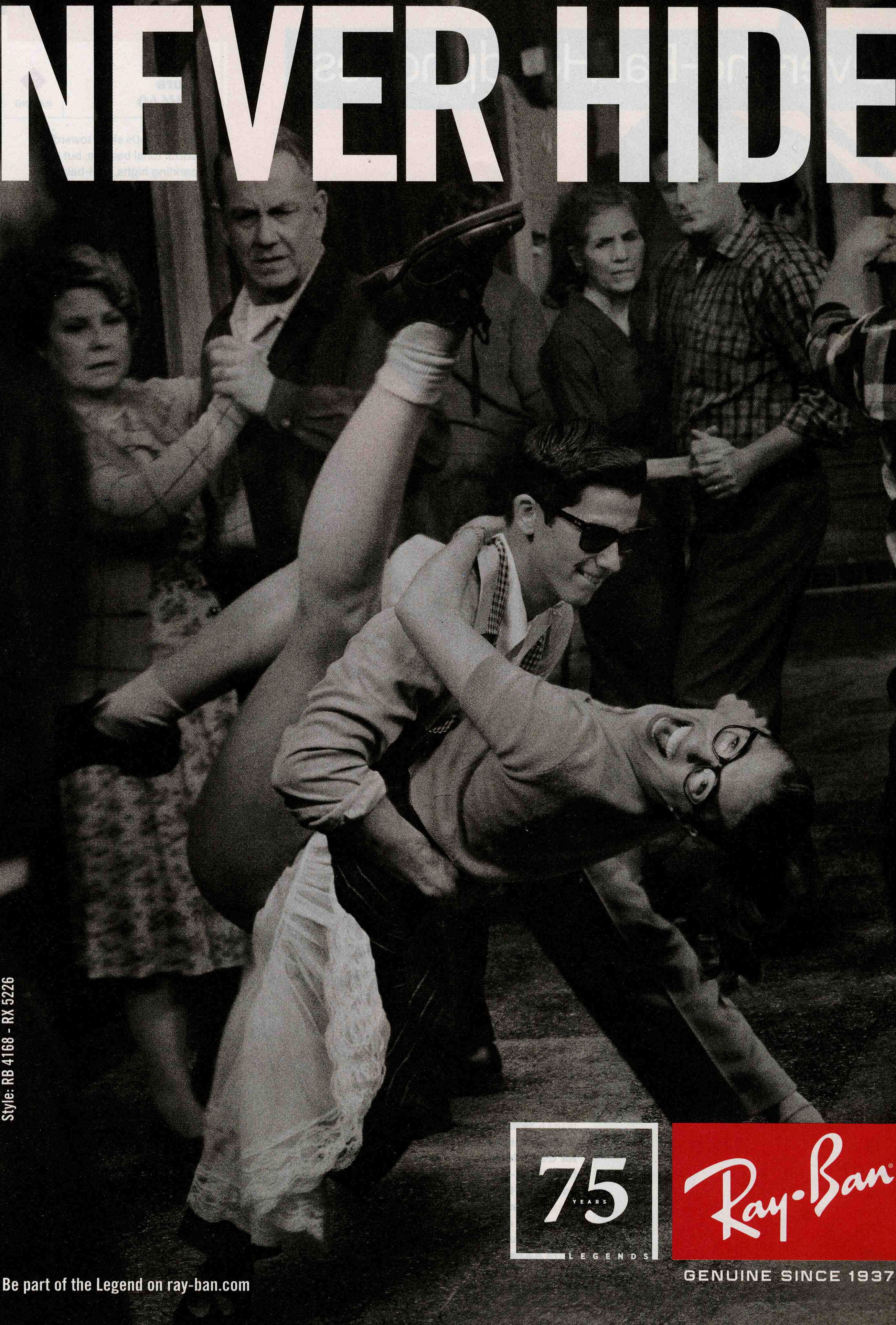
Have you seen the latest series of Ray Ban ads, running in the May issue of Wired magazine?  If not, here they are.

What can we learn from them?

  • Ads don’t need lots of copy to be effective
  • Frequency gains awareness
  • Consistency in copy builds brand positioning
  • A great photo can make a great ad
  • What’s in the background is as important as the foreground
  • A little color is sometimes more effective than a lot
  • Not everything has to be in the ad. A web site is great for extra info.
  • Change has to be consistent.

The problem with most ads is inconsistency. With the Ray Ban ads, the photos change, but the message does not – be different boldly and with pride. The headline, logo positioning, logo color, web address for more info on the left, and  anniversary mark remain the same.

The message in the series is simple. Ray Bans are for the people who stand out from the crowd. What you see here are three of five interpretations of the same concept, but unwavering attention to a consistent, simple theme. Click here to see the complete campaign.  The ads are the latest in a five-year campaign. This year’s ads celebrate the company’s 75th anniversary and celebrate people who, throughout times, flout conformity in plain site.

The Walk-away: Ads that build brands are like walking shoes. They’re built to last (apologies to Jim Collins ) by solidly supporting the brand’s message. Whether you like them or not, they’re simple, reliable and get you where you want to go.

In Advertising – Don’t Follow the Leader

When creating an ad, many entrepreneurs look to copy their top competitor — usually the leader, or the business that was first in the market. They figure whatever type of ad worked for the leader must be good enough for them. Nothing could be farther from the truth and leads to the worst kind of market positioning — forever limiting you to the me-too position, or at best – second best.

This is seen many times with auto ads, landscaping and liquor store ads. It’s hard to tell one competitor apart from the other as each advertiser copies the other. Depending on the category, these me-to ads can be either endless lists of products, similar layouts, or identical coupling strategies and color combinations. The ads do nothing to differentiate the newer entry from the established known brand in the market.

Without differentiation, consumers will always go to the established brand, and may even be willing to pay more for the established brand trust. When entering a market against an established competitor, the first rule is to differentiate yourself. Differentiation can be achieved in many ways, but it’s the advertising that lets the public in on your differentiating secret. It’s why your ad needs to be different as well.

In an earlier post, I advocated imitating ads from great national brands. Why isn’t that contradictory with this post telling you not to follow the leader? Because you need to differentiate yourself in your market. Adapting a concept from a leader outside your market can keep you fresh within your market. Creating a me-too ad in your current market does not. It keeps you racing to just catch up.

A great example are the presidential mimic radio ads for KIA dealers. If a local non-KIA dealer did the same concept it would fall flat. But, if you go to another market and happen to hear a similar spot, you realize KIA national is playing a hand in local dealer’s radio spots. And regardless of where you are in the country, you’ll recognize the mimic ads as KIA brand. For locals, it differentiates the KIA dealer from other brands. Nationally, it helps brand KIA overall.

Copy-cats ads are ineffective in any medium and don’t let you break out of the pack. Challenge your designers, media consultants or agencies to give you something different to make you stand out in your market.

The Walk-away:  When it comes to advertising, don’t follow someone else’s style. Differentiation is key. Run your own race. Take a different approach.