
Media Planning Requires Data over Ego

Here are three key tips for creating an effective media plan that gets your ad message out to potential customers:

  1. Never assume you are the customer.
  2. Don’t buy media to reach customers for your company based on your own habits.
  3. Don’t buy media based on your family’s media habits, particularly your mother’s.

The first two tips were recently re-emphasized in a study presented by the Media Behavior Institute  (MBI) during Advertising Week. As reported in Media Daily News, it found that “media pros are much more likely to be heavy users of digital media – particularly mobile and social – and are much less likely to use traditional media such as TV and radio than average customers.”

Since media pros are frequently those making media buy recommendations to business owners, it’s important to always look at data when evaluating a media plan. Can you define your core demographic and geographic reach? Is the media buy based on reach numbers targeted to your potential customers where they live and work?

Unfortunately, entrepreneurs are more likely to shoot from the hip and buy media that is either inexpensive or matches their own viewing habits. It’s the key reason behind so many car dealers pitching themselves and their families on late night local TV.  It’s an ego buy, not necessarily an effective buy — hence tip 3. Just because your mother saw you, doesn’t mean a potential customer did, nor was necessarily motivated to buy.

When buying media keep in mind this quote from MBI’s executive director of marketing Mike Bloxham:

“We all view the world from our own eyes. If we find as a community that we are markedly different from the communities that we are trying to communicate with and engage for our brand clients, that is a real challenge.”

The only antidote is data. Ask for it from any media or ad agency representative and then make your media buy accordingly. The key is objectivity. Keep your ego and mother out of it and you’ll increase your chances for an effective decision.

The Walk-away:  As your mother used to say – Never judge another person until you’ve walked in his or her shoes. Advertising is the same. Write an ad from the customer’s point of view and place it based on the customer’s media habits not your own.

Why Great Advertising Can Be Grammatically Incorrect

“Advertising is the spoken word in print.”

This is one of 52 small ideas that make a big impact from “The Little Blue Book of Advertising.”

What it means is: Grammar is best reserved for college essays, and may not have a place in effective advertising. Don’t agree? Take a moment to try and …

Think Different.

Remember that effective tag line from the 1997 Apple campaign? If not, here’s the TV spot that is still studied today as a classic. It still serves to position Apple as the product for alternative thinkers. By all accounts it worked as effective advertising. And, it’s grammatically incorrect. To get an A on an English exam, the copywriter would have written it “think differently,” and it would not have resonated or had the ad impact it did.

Advertising is fundamentally meant to “speak to” an intended audience, which is why the spoken tone is considered more effective than the grammatically correct written word.

If you’re proofing an ad for either yourself or someone else, here’s a tip:

Don’t read it quietly.

Read.

It.

Aloud.

Does the ad sound right? This tip holds for print ads as much as for radio spots. In print, readers read the ad in their own voices in their heads. Make sure the ad sounds right and it will have a better chance of resonating with your intended customers. And, if need be, keep it grammatically incorrect.

The Walk-away: Even in print, ads are meant to be ‘spoken’. If your ad doesn’t resonate in a genuine voice in a reader’s head they will discount your message as disingenuous. People like to do business with people who either “sound” like them, sound as they aspire to be.


Post originally appeared on AdsWithLegs blog created for The Press of Atlantic City, October 2012.

Update Your Ads to Resonate with Today’s Consumers

Times have changed. Has your advertising?

If your ad message, look and feel is the same as it was 5 or even 10 years ago, it’s time you got a makeover. Ads are like fashion. They need to stay up with the times, and yes – times have changed.

In colleges around the country, students of advertising are learning that they can study the culture of various times by looking at ads. That’s because ads need to be current with lifestyles in order to resonate with consumers.

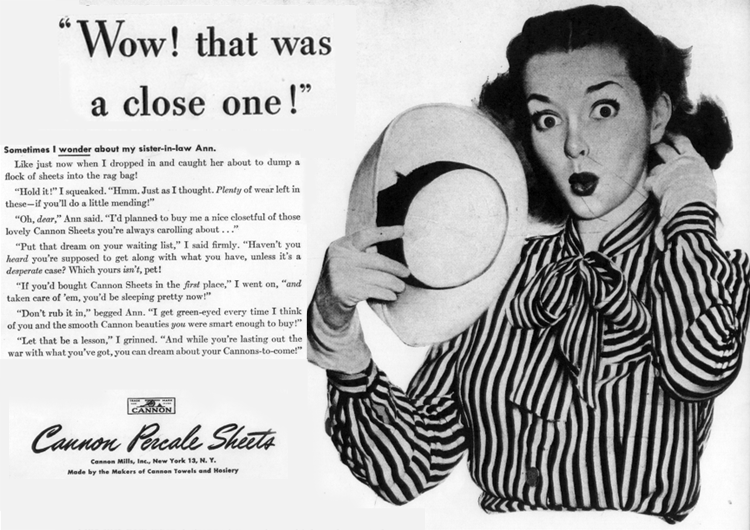
Magazine ads during World War II depict patriotic themes from women working in factories to men fighting in the fields, whereas ads from the Cold War era show a very different slice of life – women in aprons happily baking and tending to the home and men suited up for the office. These images were product agnostic and seen in promotions for everything from motor oil to fashion.

Hindsight is 20-20 and it’s easy to see now why neither type of ad imagery would work in today’s world. Not as obvious, but equally important, is the fact that ads from the early start of the Millenium also won’t work in this decade. Ten years is a new generation and requires a new generation of ads.

What ad messaging and imagery will work today? Look critically at ads that resonate with you as a consumer and consider how you might incorporate those elements in your own ads. Consider the audience you want to reach and what their current concerns may be. Although ads have changed from decade to decade, ad goals have not. Your goal is always to provide images and copy that motivate your potential target audience to take action and feel that they are getting their needs met with your products and services. Some times those needs are subliminal such as the need for security, coolness, and rarely are about price, even during a recession.

Take a new look at your ad copy. Does it speak to today’s consumer’s issues or desires? If not, you have a strong clue why your ads may not be working as they did in the past. It’s time for your long overdue makeover and to get your ads into present times.

The Walk-away: If you want your business to be relevant and resonate with today’s consumers, don’t date yourself with ad copy and graphics from 5-10 years ago. Give your ads updated legs that can walk the talk of the times.

Ad Lessons from Political Campaigns – Part 2

‘Tis still the season of political advertising and now that both major party conventions are over, the real advertising begins. If you ever think the age of big media advertising is over, just check on political campaigns. Yes, modern campaigns now effectively use social media, BUT (and it’s a big BUT) in addition to mainstream media, not in replacement of it. Why?

Candidates Need to Be Credible.

Just because a candidate says he’s the greatest doesn’t cut it. People can too easily ignore that message

The key is gaining credibility in endorsements. It’s the reason candidates value them so highly. People like to know what others are thinking and endorsement lets them jump on a trusted bandwagon. Consider your business as a candidate for consumer trust and dollars. To gain their trust, or vote, you need to be credible.

How can you gain credibility? Do what the candidates do. Get interviewed, get written about, get quoted.

How to apply it: Read the business and other sections of your newspaper and look for opportunities to pitch yourself to the appropriate editor. If there’s a new business section, send the business editor a press release on your new opening. If there’s an ongoing feature on wellness, and your business is in fitness, let the editor know what your area of expertise is and how you can offer information that may be of use in a story.

Not sure how to get started? Contact a local PR pro. If you’re comfortable doing your own PR, just make sure you’re pitching the right people about your story or area of expertise. Here’s one way to electronically pitch a story to The Press. But the best way is to get a name and contact them directly.

THEN:  If you’re printed, promote your coverage. Put a quote in an ad; frame the article and hang it up in your business; tweet about it on Twitter, or post a link to the story in Facebook. You can now promote  your increased credibility just as the candidates do!

The Walk-away: People are more receptive to advertising messages from credible sources. Use third-party mentions  by a credible source as proof that you’ve got “great legs, and soon the rest of the community will be checking out your “legs” (ahem, ad claims) as well.

What You Can Learn from Political Campaign Ads

‘Tis the season of political advertising. It’s a great opportunity to dissect effective campaign ad techniques in influencing voters, and learn how you can adopt them to influence consumer interest in your business.

Here are just the first two:

  1. Bragging Needs Bragging Rights
  2. The Hmmm Factor

We’ll cover more in future posts. You’ll likely notice highlighted similarities in each technique.There’s a reason for that. Each technique is designed to get a candidate noticed, and each is counter-intuitive to Basic Advertising Wisdom – Tell Everyone Why You’re So Great. Below each is a practical way on how to apply the technique in business advertising.

Bragging Needs Bragging Rights.  Just because you say you’re the greatest doesn’t cut it. People expect you to say you’re the best in an ad, so they can too easily ignore that message

BUT … if someone else says you’re great, then you have bragging rights. It’s the reason top brands spend big dollars on celebrity endorsements, and the reason political candidates from both parties get Keynote Speakers at their conventions. The message is: “Don’t take my word for it. Listen to these guys tell you how great I am.”

How to apply it:  Smart companies let you know their endorsements. There are many companies making sure their ads say they won a “Best of the Press” citation. Make sure to use your ads to announce whenever you are mentioned as top in your category either from a contest, reader survey, or article.

The Hmmm Factor. The goal of many political ads is to get a potential voter to say “Hmmm, didn’t think of that.” That  “Hmmm,” or  “Brain Pause” is frequently what gets a campaign humming, and a key reason political ads go negative. Positive doesn’t work as well. Why?

Just because you say you’re the greatest doesn’t cut it. People expect you to say you’re the best in an ad, so they can too easily  ignore that message

BUT … if a candidate or PAC says the other guy is not so great, a voter may say “Hmmm,” and process the ad as new “information” rather than an ad.

How to apply it:  It is not recommended to go negative in your ads on the competition. It is, however, important to get the reader to “pause” and consider your ad as information rather than a pitch. Consider ads that are Q and As, provide an insight into your commitment to the community, or find a way to personalize your company through the ad copy. The new information can get them to say “Hmmm,” and that pause means they’ve stopped to take time to consider your message.

The Walk-away: Politicians use political ads because they work. Consider the technique behind the ad and how you might be able to use it to give your ads the influence factor that drives traffic and attention to your business.

The New Way to Mail a Message – Every Door Delivery

Forget all the fancy social media platforms — Facebook, Twitter, Pinterest, Google+. Well, at least forget them until Direct Mail Legsyou’ve got the basics covered, meaning mail — from snail mail to e-mail to the newest type of mail — Every Door Direct Mail™.

Advertising is about getting your message delivered to the right customer. Mail is one of the original ad delivery vehicles, and although now out of favor, can still be an effective way to reach a geo-targeted audience, especially if done in a modern way. Direct mail, the original mailing mechanism through the post office, is now expensive and inefficient leading digital age advertisers to move from snail mail to e-mail. But, the surprise and delight factor is not the same. Whereas “junk mail” was frequently fun to receive; spam is not.

Unlike email, direct mail is a tactile experience. To this day, with the exception of  bills, everyone generally still  loves getting mail. It’s the reason direct mail will never totally go away. But, now, a new affordable replacement is literally on everyone’s doorstep – targeted house delivery, or Every Door Direct Mail. How’s Every Door Direct different from Direct Mail?

  • The piece is not personalized. Although not as strong as a personalized piece, for the greatly reduced cost, it gets your message directly into the home. The plus side is the mailer also doesn’t have to preprint addresses on each piece.
  • It can  be geo-targeted, something extremely valuable particularly for local retailers and service businesses. Do you want to reach all households in a particular zip or carrier route? This does it.
  • The mail is  still “delivered” by the postal service (USPS), but all the paperwork is done by the Every Door vendor.
  • The piece can range from a door hanger, to a flyer, or even an item in an envelope. In other words, you don’t have to abide by Postal standards for size or weight.
  • It’s a lot less expensive. Whereas a first class piece can range from 37 cents to well over a dollar depending on size, a Direct Delivery piece is generally less than 20 cents per household.

Today, targeted house delivery is available through a series of private party providers, including local newspapers. In South Jersey, The Press of Atlantic City is making the service available, just as other providers are across the nation. Is it an option for you? It is, likely, at least an option you should explore by talking to your local Every Door Direct representative or call (609) 272-7002.

The Walk-away: Direct mail has evolved with more options for unique targeting and creative designs to cut through the clutter. Walking to get your mail is still exciting when you get an unexpected delivery message in a unique way.

For Advertising Wisdom – Go Fly a Kite

Advertisers frequently make the mistake of putting out one ad, one time, and waiting to see what happens. If it works, they think, they’ll do it again. And, if it doesn’t, they won’t. The odds are very strong the ad won’t work because their ad strategy is, in effect, spitting into the wind. To understand why, let’s take the analogy a bit higher and drier. Let’s go kite flying.

Ads with legs kite photoImagine your ad is a kite on a long string and you fly it once for 5 minutes. That’s a long time because the average ad is seen or heard for less than 30 seconds in broadcast, and under one minute in print. How many people do you think will have seen your kite and commented on it?

What if your kite stays up for hours on end? That’s called Frequency –  meaning that you’re giving consumers several options for seeing your kite over time.

Finally, fly your kite on a crowded beach during the height of summer. That’s called Reach. You’re reaching thousands more people than if you flew the same gorgeous kite for the same amount of time in a desolate area.

Now, let’s assume your kite is a plain white kite. Even if it’s the only one in the sky, it may get overlooked as it blends with the clouds. It is not distinctive. In this case, it’s seen but not remembered and has no impact. Make your kite colorful, or extraordinarily designed, and it now stands out. That’s called getting noticed, the first key component in an increasingly cluttered competitive field.

But, what if you need your kite to be noticed during a windy day when everyone’s come out to fly kites? You might be better off having that plain white kite to set you apart from the sea of colorful kites. In design that’s a positive use of negative space, or differentiation.

Now, imagine you fly your kite long enough to break the Guinness Book of World Records. What type of PR benefits will you now get? Welcome to the world of public relations – a topic for another time.Ads with legs plane photo

The Walk-away: Ads that work let you successfully fight the battle for client attention and send your business soaring. But, as the Wright Brothers knew, flying successfully takes practice and planning. Advertising, like aerodynamics, is a science. Study the principles and you could be flying in no time like a trained pro.

Not All Ad Positions Are Created Equal

In advertising, not all ad positions are created equal. That should come as no surprise to advertisers.  Every media has its star positions and remnants.

  • Radio morning drive time is valued over all other time slots.
  • In TV, prime time – 7-10pm – is the coveted time slot.
  • For magazines, right-paged ads get more eyeballs than left-page placements, and front of the book or inside covers are clearly premium spots.
  • In newspapers, above-the-fold positions are the“top” spots, but a below-the-fold strip ad on a section front also has extremely high value.

This is all common advertising wisdom, but effective ad placement is not always that cut and dry. Newspaper data, for instance, shows that comics and lifestyle columns are highly read and, yet, most advertisers overlook these key positions when creating their media plans. Don’t try to run next to Dear Abby or Garfield in The New York Times, since the Grey Lady doesn’t carry those features. But if you’re a local psychologist introducing a new service in an area served by a regional paper, an adjacency to Dear Abby or Carolyn Hax, Abbey’s younger counterpart in newspaper advice columns, might be just the ticket for getting the right eyeballs to your ad.

Positioning means just that – the position of your ad. It can include adjacencies to key features, or a “Blue Ocean” spot. For instance, a mortgage financing company should find that a newspaper ad adjacency to real estate listings is both more affordable than an above-the-fold ad in regional news AND more effective due to the readership affinity with real estate listing readers. The same would hold true in an online environment.

A “Blue Ocean” spot is one where other advertisers may not normally appear, giving you an open space, or blue ocean spot, to get your message clearly across without clutter from your competitors. An example of this is a recent real estate ad placed in Hometown, the zoned community section of The Press of Atlantic City, rather than in the real estate section. In this case, the realtor was effectively targeting interested residents from a specific area for attention to a unique property. It doesn’t mean the ad should not also run in real estate, but the positioning clearly set this ad apart from competitors. And that’s the point of all advertising — gain attention towards you and away from competitors.

Ad positioning is both an art and a strategic play. Great positioning means your ad is where  the right people will see, hear or interact with it. But positioning alone doesn’t make for ad effectiveness. For instance, an auto detailing ad in a Sunday afternoon radio hour may be inexpensive, but not worth the dollars paid for it. Why? Radio listenership plummets on weekends except for morning religious shows for the homebound.

No matter the media, great positioning is the result of being in the right place at the right time to reach the right people.

The Walk-away: Positioning is one leg of three-legged stool – with the other two legs always being Reach and Frequency. Just as with a stool, one leg of a media plan won’t give you a strong platform. You need all three solidly in place at all times.

Lessons from a Leader – Ray Ban Ads

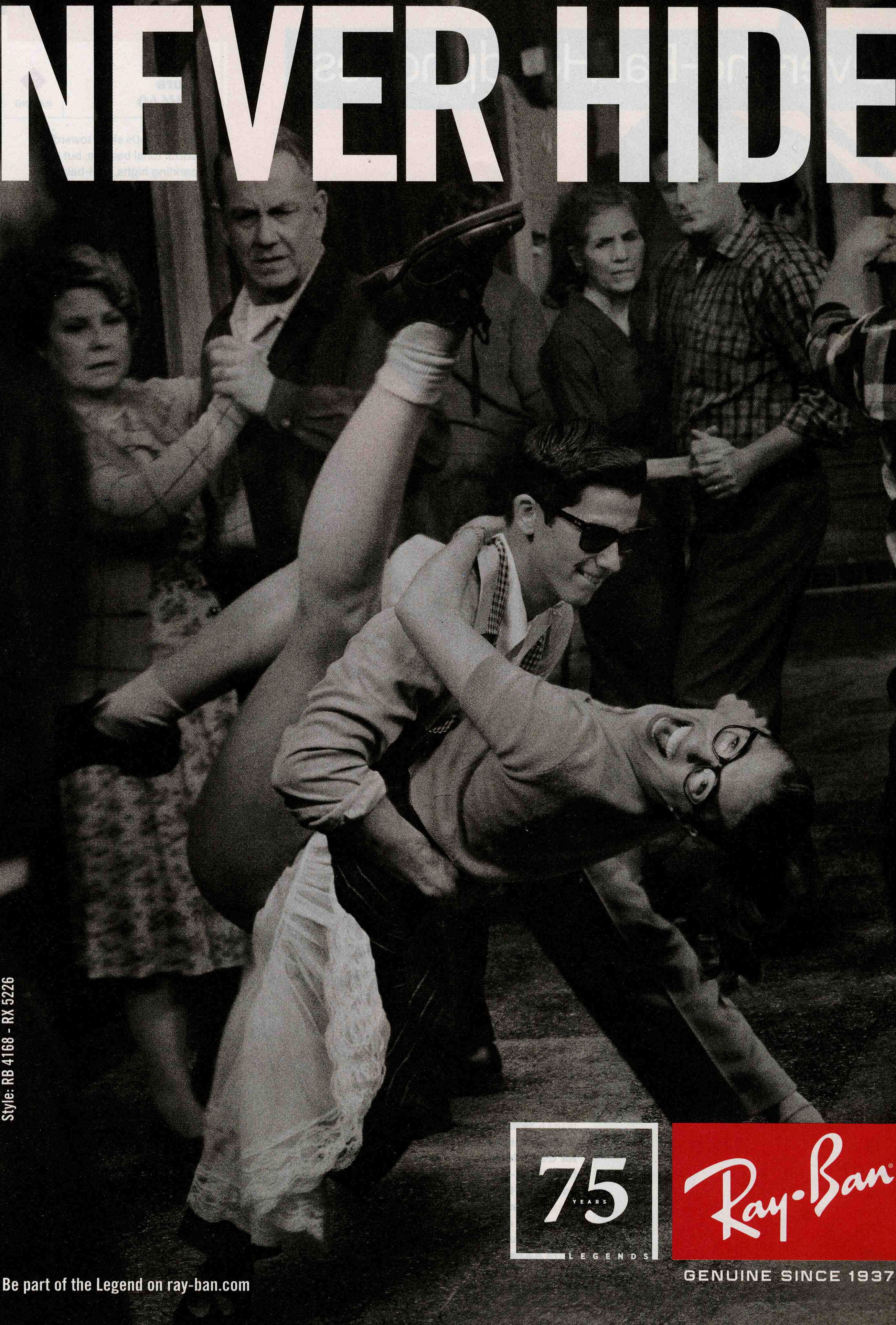
Have you seen the latest series of Ray Ban ads, running in the May issue of Wired magazine?  If not, here they are.

What can we learn from them?

  • Ads don’t need lots of copy to be effective
  • Frequency gains awareness
  • Consistency in copy builds brand positioning
  • A great photo can make a great ad
  • What’s in the background is as important as the foreground
  • A little color is sometimes more effective than a lot
  • Not everything has to be in the ad. A web site is great for extra info.
  • Change has to be consistent.

The problem with most ads is inconsistency. With the Ray Ban ads, the photos change, but the message does not – be different boldly and with pride. The headline, logo positioning, logo color, web address for more info on the left, and  anniversary mark remain the same.

The message in the series is simple. Ray Bans are for the people who stand out from the crowd. What you see here are three of five interpretations of the same concept, but unwavering attention to a consistent, simple theme. Click here to see the complete campaign.  The ads are the latest in a five-year campaign. This year’s ads celebrate the company’s 75th anniversary and celebrate people who, throughout times, flout conformity in plain site.

The Walk-away: Ads that build brands are like walking shoes. They’re built to last (apologies to Jim Collins ) by solidly supporting the brand’s message. Whether you like them or not, they’re simple, reliable and get you where you want to go.