
Update Your Ads to Resonate with Today’s Consumers

Times have changed. Has your advertising?

If your ad message, look and feel is the same as it was 5 or even 10 years ago, it’s time you got a makeover. Ads are like fashion. They need to stay up with the times, and yes – times have changed.
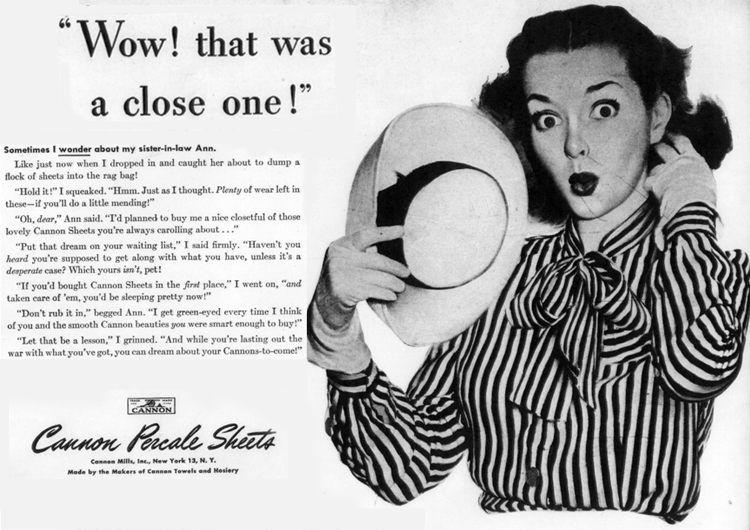
In colleges around the country, students of advertising are learning that they can study the culture of various times by looking at ads. That’s because ads need to be current with lifestyles in order to resonate with consumers.

Magazine ads during World War II depict patriotic themes from women working in factories to men fighting in the fields, whereas ads from the Cold War era show a very different slice of life – women in aprons happily baking and tending to the home and men suited up for the office. These images were product agnostic and seen in promotions for everything from motor oil to fashion.

Hindsight is 20-20 and it’s easy to see now why neither type of ad imagery would work in today’s world. Not as obvious, but equally important, is the fact that ads from the early start of the Millenium also won’t work in this decade. Ten years is a new generation and requires a new generation of ads.

What ad messaging and imagery will work today? Look critically at ads that resonate with you as a consumer and consider how you might incorporate those elements in your own ads. Consider the audience you want to reach and what their current concerns may be. Although ads have changed from decade to decade, ad goals have not. Your goal is always to provide images and copy that motivate your potential target audience to take action and feel that they are getting their needs met with your products and services. Some times those needs are subliminal such as the need for security, coolness, and rarely are about price, even during a recession.

Take a new look at your ad copy. Does it speak to today’s consumer’s issues or desires? If not, you have a strong clue why your ads may not be working as they did in the past. It’s time for your long overdue makeover and to get your ads into present times.

The Walk-away: If you want your business to be relevant and resonate with today’s consumers, don’t date yourself with ad copy and graphics from 5-10 years ago. Give your ads updated legs that can walk the talk of the times.


What You Can Learn from Political Campaign Ads

‘Tis the season of political advertising. It’s a great opportunity to dissect effective campaign ad techniques in influencing voters, and learn how you can adopt them to influence consumer interest in your business.

Here are just the first two:

  1. Bragging Needs Bragging Rights
  2. The Hmmm Factor

We’ll cover more in future posts. You’ll likely notice highlighted similarities in each technique.There’s a reason for that. Each technique is designed to get a candidate noticed, and each is counter-intuitive to Basic Advertising Wisdom – Tell Everyone Why You’re So Great. Below each is a practical way on how to apply the technique in business advertising.

Bragging Needs Bragging Rights.  Just because you say you’re the greatest doesn’t cut it. People expect you to say you’re the best in an ad, so they can too easily ignore that message

BUT … if someone else says you’re great, then you have bragging rights. It’s the reason top brands spend big dollars on celebrity endorsements, and the reason political candidates from both parties get Keynote Speakers at their conventions. The message is: “Don’t take my word for it. Listen to these guys tell you how great I am.”

How to apply it:  Smart companies let you know their endorsements. There are many companies making sure their ads say they won a “Best of the Press” citation. Make sure to use your ads to announce whenever you are mentioned as top in your category either from a contest, reader survey, or article.

The Hmmm Factor. The goal of many political ads is to get a potential voter to say “Hmmm, didn’t think of that.” That  “Hmmm,” or  “Brain Pause” is frequently what gets a campaign humming, and a key reason political ads go negative. Positive doesn’t work as well. Why?

Just because you say you’re the greatest doesn’t cut it. People expect you to say you’re the best in an ad, so they can too easily  ignore that message

BUT … if a candidate or PAC says the other guy is not so great, a voter may say “Hmmm,” and process the ad as new “information” rather than an ad.

How to apply it:  It is not recommended to go negative in your ads on the competition. It is, however, important to get the reader to “pause” and consider your ad as information rather than a pitch. Consider ads that are Q and As, provide an insight into your commitment to the community, or find a way to personalize your company through the ad copy. The new information can get them to say “Hmmm,” and that pause means they’ve stopped to take time to consider your message.

The Walk-away: Politicians use political ads because they work. Consider the technique behind the ad and how you might be able to use it to give your ads the influence factor that drives traffic and attention to your business.

Is It Worth Paying for Color in Print Ads?

What’s the value of color for a print ad?  For most publications, color is an up-charge from as low as $2 per inch to sometimes more than double the base charge. How can you determine if it’s worth the additional investment?

In general, research consistently shows that color ads out pull black and white ads of the same size with the same message. One 2009 study on color ads in US Newspapers conducted by Research and Analysis of Media found the following:

Color helps readers remember ads.

  • Full color increased ad recall (readers who remembered seeing an ad) by 23%.
  • Spot color increased ad recall by 15%.

Color helps ads of all sizes, but has the most impact  on full page ads.

  • Recall went up by 6% in quarter page ads, 8% in half page ads, and 23% in full page ads.

Color makes an advertiser appear interesting and fresh.

  • 15% found the ads more interesting and 29% said the ads communicated a fresh approach.

Color drives traffic and a reader’s potential to buy from the advertiser.

  • When compared with the same ad in black and white, 6% more said they would seek more information,while 8% more said they would visit the advertiser.
  • 12 % more said they either have bought or plan to buy from the advertiser.

These are compelling reasons to consider color, but as with all ad techniques, there are no hard and fast rules. If you’re a high-end, luxury retailer advertising in an artsy magazine, you could make the case that a glossy black and white ad makes the statement you need.  It this case, the black and white choice is not about budget, but a desired image. For most small to mid-sized businesses, the  data on color indicates you should try to present your message through rose, if not multi-colored glasses.

The Walk-away: Color in print helps readers see you more clearly. It generally makes them more willing to engage with you rather than stepping aside and letting you pass  by.

Packaging – The Frequently Overlooked Marketing Key

Every marketing student learns about the five “p’s” of marketing – Pricing, Place, Product, Promotion, and People. The missing “P” is packaging, which some will teach is part of Product, and others will claim is part of Promotion. Either way, it’s frequently the forgotten child of marketing that can spell business success or failure.

A key case in point is Coca-Cola. Without a doubt, Coke is always discussed in conversations about great brands. Recently, the story of Coke was featured on CBS Sunday Morning, itself a perennial news brand. As the story goes, Coca-Cola was so successful, that me-too products popped up around the globe. In a marketing meeting, Coke executives realized their brand franchise was in danger, and decided to invent brand packaging – the now iconic coke bottle – so that even in the dark, by feel alone, a consumer would know “the real thing” from a substitute. When aluminum cans became the norm, color became a larger concern for differentiating the brand, and Coke’s “red” became another text-book marketing example of the importance of color in serious brand management.

How does this apply to you if you’re a small to mid-sized business not of Coke caliber? Don’t underestimate packaging as a key differentiating factor. Packaging means everything from how you label your business to how you package your goods and services. Consider these examples:

  • Where The Art Is – This party decorations firm located in Paramus, NJ was literally started out of a garage. The decorations are unique and memorable, with many centerpieces kept for years to come in the homes of the guests and/or hosts. Under each piece is the company’s label with contact information. If you want a party decorator years later, you’ll be able to find Where The Art Is due to a simple packaging label.
  • Chico’s – Now a well known women’s wear franchise, the store endeared itself to women through a wrinkle-free travel line that was also figure forgiving. Priced high, consumers don’t feel cheated as each purchase is carefully wrapped generously in beautiful tissue paper and each bag is tied off with rainbow ribbons. Both touches are not necessary and add extra expense, but both are part of the Chico’s experience and brand.
  • Two Tin Crows – This unique gift store in Northfield, NJ (outside of Atlantic City), makes sure that gifts are beautifully wrapped using bags folded just so. It’s a simple technique, but one done exquisitely by the owner. It takes the added expense of gift wrapping off the consumer and makes the purchase that much easier. The point of these three examples is that it only takes a little extra effort to make your packaging work wonders for you as a differentiating value proposition.

The Walk-away: Take a look at your packaging, from your windows to your logo. Are you doing all you can to put your best look — if not foot — forward? Packaging is a Key “P” in Marketing.

For Advertising Wisdom – Go Fly a Kite

Advertisers frequently make the mistake of putting out one ad, one time, and waiting to see what happens. If it works, they think, they’ll do it again. And, if it doesn’t, they won’t. The odds are very strong the ad won’t work because their ad strategy is, in effect, spitting into the wind. To understand why, let’s take the analogy a bit higher and drier. Let’s go kite flying.

Ads with legs kite photoImagine your ad is a kite on a long string and you fly it once for 5 minutes. That’s a long time because the average ad is seen or heard for less than 30 seconds in broadcast, and under one minute in print. How many people do you think will have seen your kite and commented on it?

What if your kite stays up for hours on end? That’s called Frequency –  meaning that you’re giving consumers several options for seeing your kite over time.

Finally, fly your kite on a crowded beach during the height of summer. That’s called Reach. You’re reaching thousands more people than if you flew the same gorgeous kite for the same amount of time in a desolate area.

Now, let’s assume your kite is a plain white kite. Even if it’s the only one in the sky, it may get overlooked as it blends with the clouds. It is not distinctive. In this case, it’s seen but not remembered and has no impact. Make your kite colorful, or extraordinarily designed, and it now stands out. That’s called getting noticed, the first key component in an increasingly cluttered competitive field.

But, what if you need your kite to be noticed during a windy day when everyone’s come out to fly kites? You might be better off having that plain white kite to set you apart from the sea of colorful kites. In design that’s a positive use of negative space, or differentiation.

Now, imagine you fly your kite long enough to break the Guinness Book of World Records. What type of PR benefits will you now get? Welcome to the world of public relations – a topic for another time.Ads with legs plane photo

The Walk-away: Ads that work let you successfully fight the battle for client attention and send your business soaring. But, as the Wright Brothers knew, flying successfully takes practice and planning. Advertising, like aerodynamics, is a science. Study the principles and you could be flying in no time like a trained pro.

Not All Ad Positions Are Created Equal

In advertising, not all ad positions are created equal. That should come as no surprise to advertisers.  Every media has its star positions and remnants.

  • Radio morning drive time is valued over all other time slots.
  • In TV, prime time – 7-10pm – is the coveted time slot.
  • For magazines, right-paged ads get more eyeballs than left-page placements, and front of the book or inside covers are clearly premium spots.
  • In newspapers, above-the-fold positions are the“top” spots, but a below-the-fold strip ad on a section front also has extremely high value.

This is all common advertising wisdom, but effective ad placement is not always that cut and dry. Newspaper data, for instance, shows that comics and lifestyle columns are highly read and, yet, most advertisers overlook these key positions when creating their media plans. Don’t try to run next to Dear Abby or Garfield in The New York Times, since the Grey Lady doesn’t carry those features. But if you’re a local psychologist introducing a new service in an area served by a regional paper, an adjacency to Dear Abby or Carolyn Hax, Abbey’s younger counterpart in newspaper advice columns, might be just the ticket for getting the right eyeballs to your ad.

Positioning means just that – the position of your ad. It can include adjacencies to key features, or a “Blue Ocean” spot. For instance, a mortgage financing company should find that a newspaper ad adjacency to real estate listings is both more affordable than an above-the-fold ad in regional news AND more effective due to the readership affinity with real estate listing readers. The same would hold true in an online environment.

A “Blue Ocean” spot is one where other advertisers may not normally appear, giving you an open space, or blue ocean spot, to get your message clearly across without clutter from your competitors. An example of this is a recent real estate ad placed in Hometown, the zoned community section of The Press of Atlantic City, rather than in the real estate section. In this case, the realtor was effectively targeting interested residents from a specific area for attention to a unique property. It doesn’t mean the ad should not also run in real estate, but the positioning clearly set this ad apart from competitors. And that’s the point of all advertising — gain attention towards you and away from competitors.

Ad positioning is both an art and a strategic play. Great positioning means your ad is where  the right people will see, hear or interact with it. But positioning alone doesn’t make for ad effectiveness. For instance, an auto detailing ad in a Sunday afternoon radio hour may be inexpensive, but not worth the dollars paid for it. Why? Radio listenership plummets on weekends except for morning religious shows for the homebound.

No matter the media, great positioning is the result of being in the right place at the right time to reach the right people.

The Walk-away: Positioning is one leg of three-legged stool – with the other two legs always being Reach and Frequency. Just as with a stool, one leg of a media plan won’t give you a strong platform. You need all three solidly in place at all times.